

What’s New in Budget 2026?
Every year, the Union Budget brings the same question: am I going to pay more tax, or less? Budget 2026 doesn’t have a dramatic answer to that, and that’s not the worst thing.
This year wasn’t about big announcements. The government is targeting 10% nominal GDP growth, holding the fiscal deficit at 4.3% of GDP, and keeping capital expenditure high at ₹12.2 lakh crore. The message behind all of this is pretty straightforward: we’re being careful, not flashy. There’s also a plan to bring debt-to-GDP down to around 50% by FY31, which is a longer game than most people pay attention to.
If you’re trying to plan your investments or just get a handle on how the year looks financially, that kind of consistency is more useful than it gets credit for. You can actually make decisions when the ground isn’t shifting under you.
Profito Insight:
When the budget doesn’t surprise you, that’s your window to plan well. Use it.
What This Budget Means for Salaried Individuals
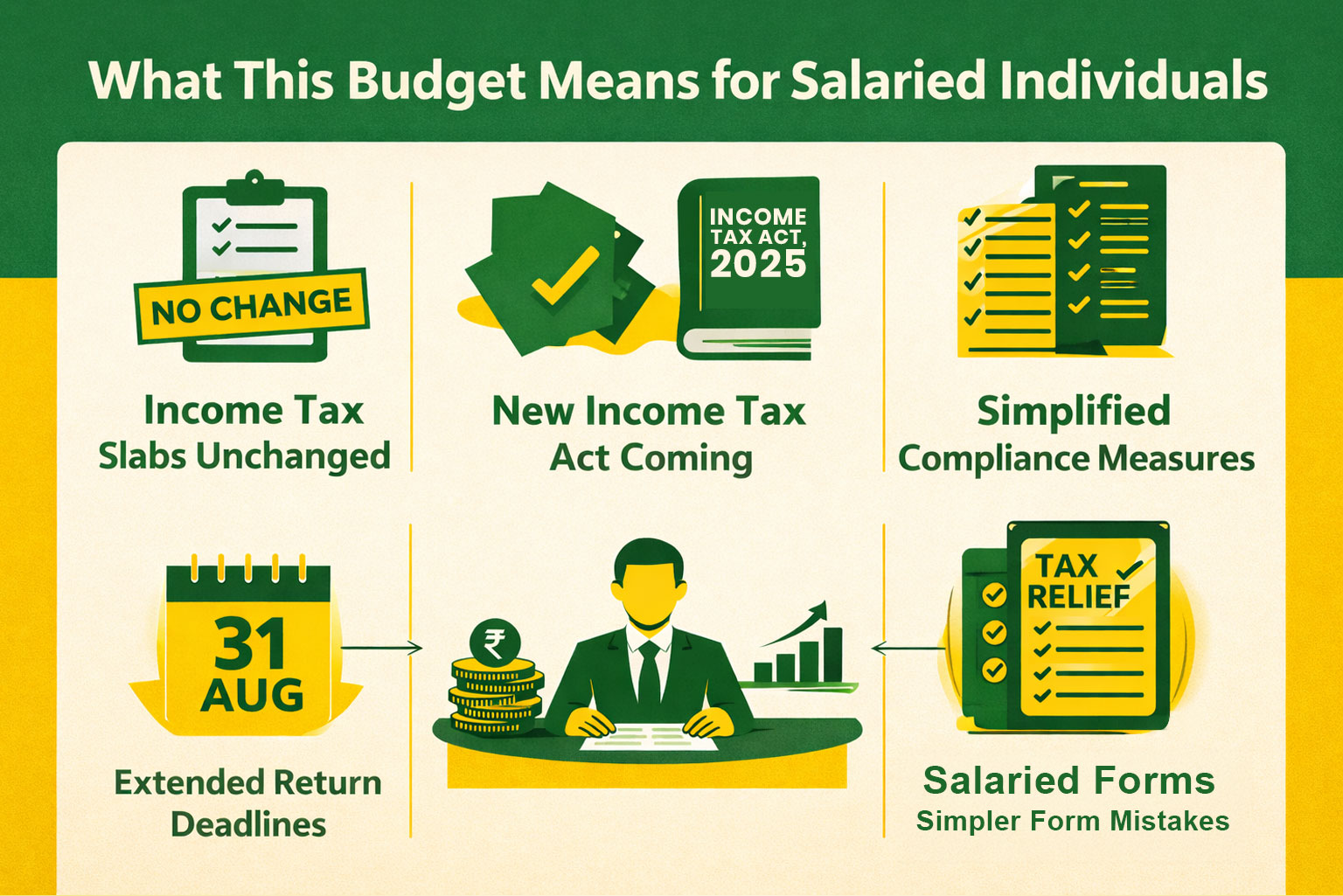
1. No Change in Income Tax Slabs
No changes to income tax rates this year, whether you’re on the old regime or the new one. A lot of salaried folks were hoping for some relief there, and it’s fair to feel a little underwhelmed. But a stable tax structure isn’t nothing. When the rules don’t change, planning gets easier.
Strategic Insight
Waiting around for a tax cut that may or may not come isn’t a strategy. What you can control is how well you’re using the structure that already exists. Most people are leaving money on the table simply because they haven’t revisited their tax planning in a while. A year with no surprises is actually a good year to sit down, look at your investments, and make sure your money is working as hard as it should be.
2. New Income Tax Act, 2025 (Effective 1 April 2026)
(Effective from 1 April 2026)
One of the quieter but genuinely useful things coming out of this budget is the upcoming Income Tax Act 2025. The existing tax code has been patched and amended so many times over the decades that even accountants sometimes disagree on what it actually says. The new act is meant to fix that, with clearer language, simpler forms, and less room for confusion.
Strategic Insight
This matters more than it sounds. When tax rules are hard to follow, most people either overpay out of caution or miss out on benefits they were entitled to. A cleaner, more readable tax law means you can actually understand what applies to you, without needing to decode it first. Less time on compliance, more time on the stuff that actually grows your wealth.
3. Extended Return Timelines
The government has quietly extended a couple of important deadlines, and if you’ve ever filed a return in a rush, you’ll appreciate this. Revised returns can now be filed until 31 March, and for non-audit cases, the deadline has been pushed to 31 August.
What This Means
More time doesn’t just reduce stress; it reduces mistakes. A lot of errors in tax filing happen simply because people are scrambling at the last minute, missing a document here, forgetting an income entry there. If you have investments or any income outside your salary, this extra runway gives you the space to actually get it right rather than just get it done.
4. Relief & Compliance Simplifications
A few smaller changes in this budget that are worth knowing about, even if they won’t make headlines.
If you’ve made minor errors in reporting foreign assets under ₹20 lakh, the treatment is now lighter, less of an immediate penalty situation. There’s also a new window to declare foreign income or assets, which is useful if you’ve been unsure about how to handle that. On the property side, buying from a non-resident just got a little less complicated. TAN requirements have been relaxed, so buyers can now use a PAN-based challan instead of applying for a separate TAN. In some cases, flat fees are replacing what used to be penalties.
What This Means
The government isn’t overhauling the system, but it is sanding down some of the rougher edges. For most regular taxpayers, this means fewer situations where an honest mistake turns into a disproportionate headache. The overall direction is toward compliance being something you can manage without dreading it.
What This Budget Means for Investors
1. Higher STT on Futures and Options
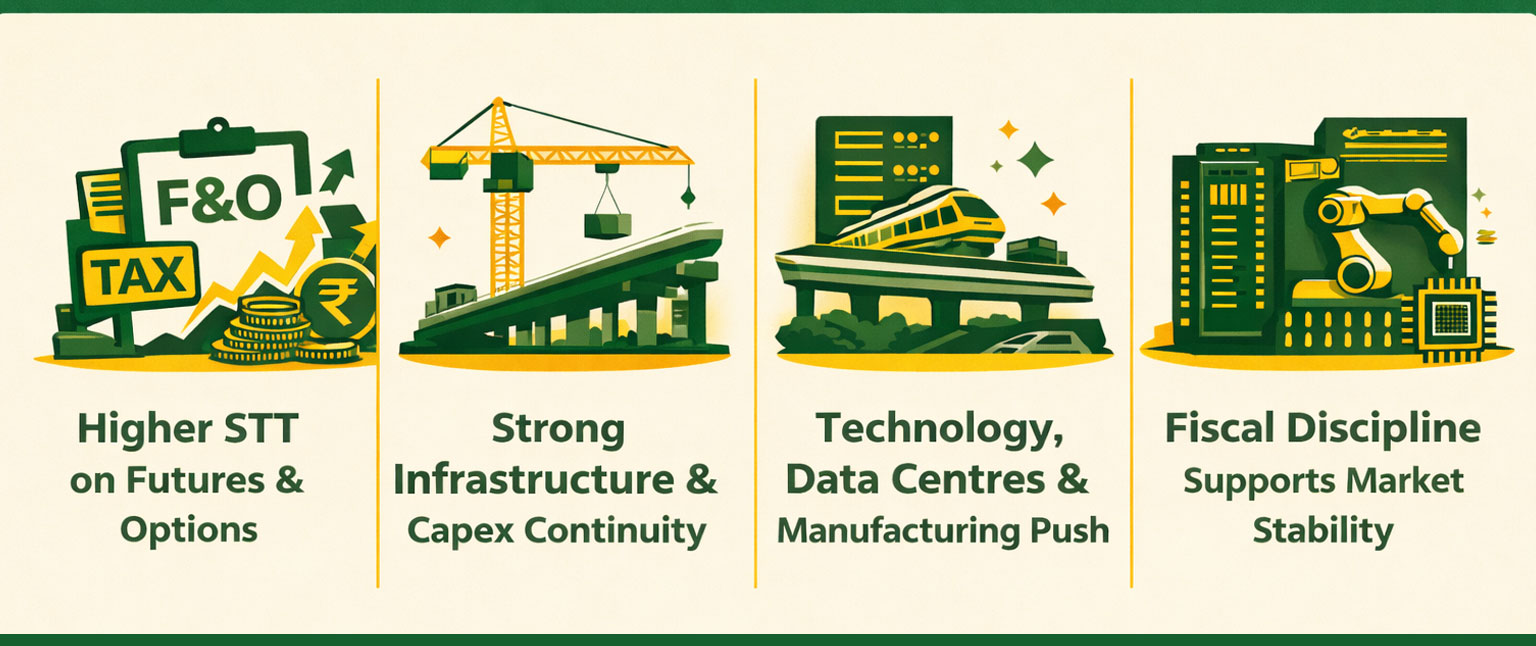
Tax on futures and options trading has gone up. Every derivatives trade now costs a little more than it did before.
What This Means
This is less of a crisis and more of a nudge. F&O trading was already expensive once you factored in brokerage, GST, and the odds stacked against retail traders. The higher tax just makes the math a little harder to justify. If you’ve been dabbling in derivatives hoping for quick gains, this is a reasonable moment to ask whether that’s actually working for you. For most salaried investors, staying in the market steadily tends to do more for your wealth than trying to time it.
2. Strong Infrastructure & Capex Continuity
Infrastructure is where the government is clearly putting its weight. ₹12.2 lakh crore in capital expenditure keeps the momentum going on railways, logistics networks, and transport corridors that have been in the works for years.
What This Means
Large infrastructure projects don’t move fast, but they move steadily. Companies in construction, logistics, and related sectors tend to benefit as these projects progress through their lifecycle, often over many years. It’s not the kind of thing that shows up dramatically in a quarterly result, but it compounds quietly in the background.
Strategic View
Chasing short-term market moves is exhausting and usually unrewarding. Sectors with strong government backing behind them offer something more useful: a reason to stay invested. If your portfolio has little to no exposure to infrastructure-linked businesses, this budget is a good prompt to revisit that.
3. Technology, Data Centers & Manufacturing Push
Technology and manufacturing continue to get clear policy backing. Tax benefits for data centres, a unified safe harbour rate for IT services, and sustained support for semiconductor and electronics manufacturing all point in the same direction: India is serious about building out its digital and industrial base, not just talking about it.
What This Means
Data centres, AI infrastructure, and electronics manufacturing are not niche bets anymore. They’re becoming foundational to how the economy runs. As India pushes to reduce import dependence in tech hardware and grow its share of global digital infrastructure, the companies operating in these spaces have a reasonably long runway ahead of them.
Strategic View
The mistake most investors make is waiting for these trends to become obvious before getting in, at which point a lot of the upside is already priced in. Technology and manufacturing are slow-burn themes that reward patience more than timing. If you’re already invested in these sectors, this budget reinforces the case for staying put. If you’re not, it’s worth a conversation about whether you should be
4. Fiscal Discipline Supports Market Stability
The government is holding the fiscal deficit at 4.3% of GDP, with a stated plan to bring debt levels down steadily over the coming years. No dramatic moves, just a clear commitment to not letting the numbers get out of hand.
What This Means
Fiscal discipline doesn’t make for exciting headlines, but it matters. When the government keeps its borrowing in check, it leaves more room for private investment, keeps inflation pressures lower, and generally makes the economic environment more predictable. For investors, predictable environments are good environments.
Strategic View
Markets don’t just respond to growth; they respond to confidence. A government that is managing its finances carefully sends a signal that the rules of the game aren’t about to change overnight. That kind of stability is easy to overlook when everything is going well, but it’s exactly what protects your portfolio when things get choppy. Steady conditions, built over time, tend to do more for long-term wealth than any single market opportunity.
What Smart Investors Should Do Post Budget 2026
Budgets are easy to read and forget. The more useful habit is to actually do something with the information while it’s fresh.
For Salaried Professionals
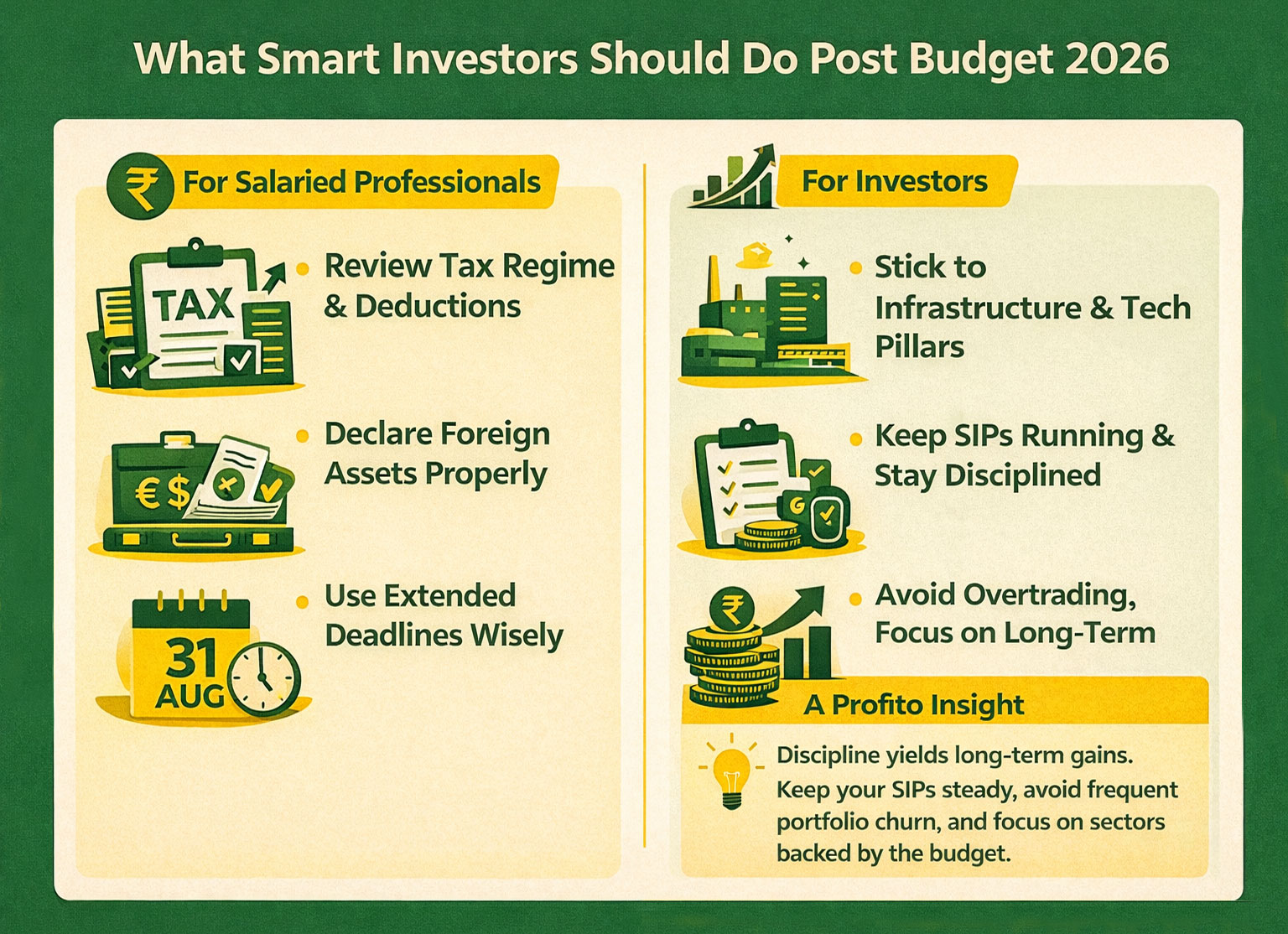
Start with the basics: which tax regime are you on, and is it still the right one for you? This is worth checking every year, not just when the budget changes something. If you haven’t fully used deductions like 80C, NPS, or health insurance, that’s money you’re leaving behind without much reason to.
If you have foreign investments or assets, get them declared correctly. The rules around this have become clearer and the penalties lighter, but only if you’re on the right side of them. And with return deadlines now extended, there’s no excuse to rush and make avoidable mistakes. Use the extra time to actually get your documents in order rather than filing in a panic at the last minute.
For Investors
This budget doesn’t change the playbook; it reinforces it. Infrastructure, manufacturing, technology, data centres, and agri-linked businesses all have clear policy tailwinds behind them. These aren’t short-term trades; they’re areas where patient capital tends to get rewarded.
A Profito Insight
With trading costs going up, churning your portfolio frequently is becoming an even worse idea than it already was. Keep your SIPs running, stay disciplined, and resist the urge to react to every market move. The economic conditions this budget is trying to build, stable growth, managed deficits, and long-term sectoral investment, are exactly the kind of backdrop where boring, consistent investing tends to win.
A Stable Economic Outlook Ahead
The broader picture looks stable. The government is targeting 10% nominal GDP growth for FY27, and income tax collections are expected to grow by 11.7%, which reflects an economy that’s moving, even if not dramatically. The government is staying the course on deficit reduction and debt management, which keeps the financial foundation solid without requiring any dramatic intervention.
Profito View
This wasn’t a budget designed to excite anyone. It was designed to keep things on track, and in many ways that’s exactly what long-term investors should want. Flashy budgets with big announcements tend to create short-term noise and not much else. A budget that quietly reinforces stable growth, backs the right sectors, and keeps fiscal discipline intact is one you can actually build a financial plan around. That’s what this one does.
Risks & Watch Areas
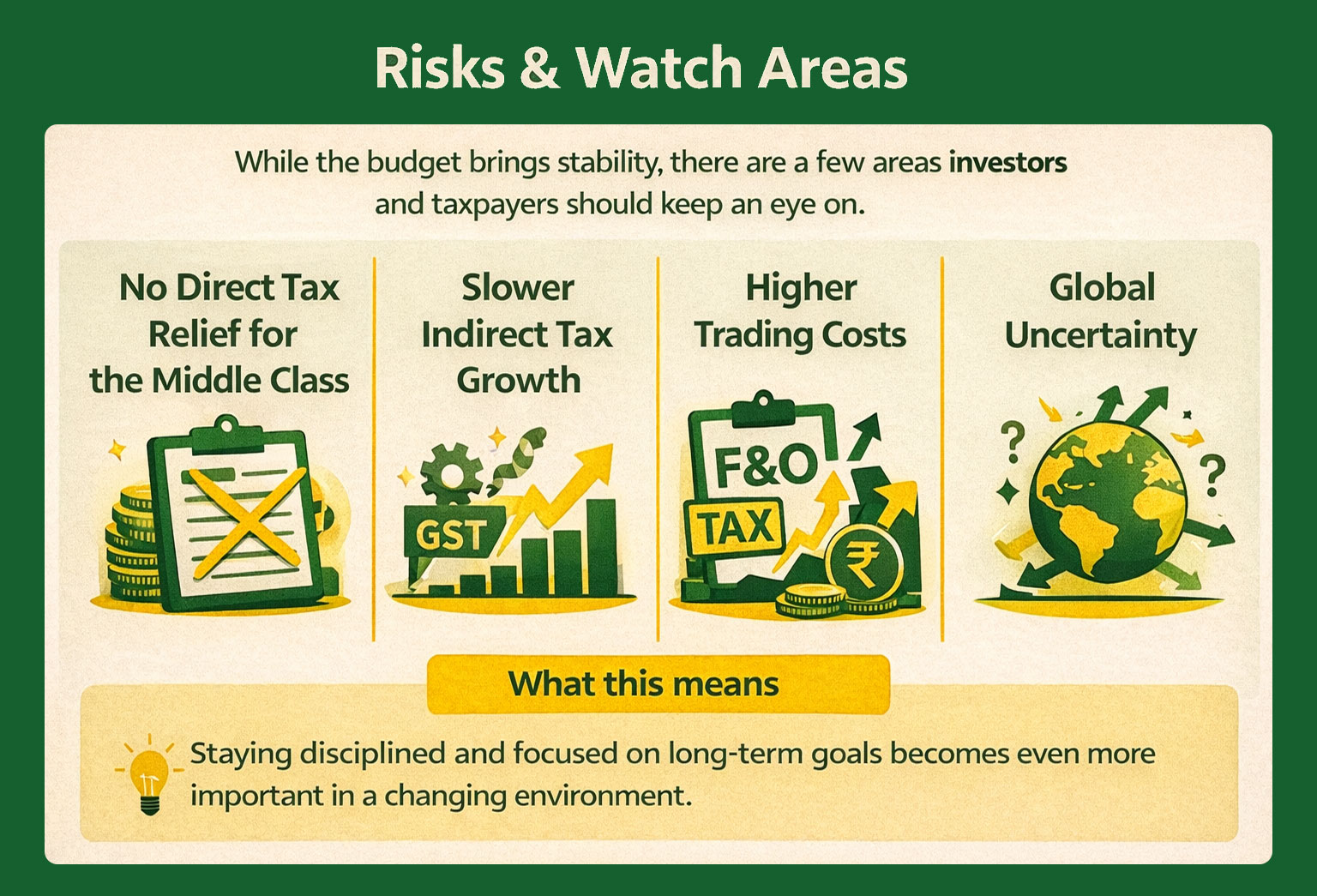
While the budget brings stability, there are a few areas investors and taxpayers should keep an eye on.
1. No Direct Tax Relief for the Middle Class
The absence of tax relief means salaried individuals will need to rely more on careful planning to manage their finances.
2. Slower Indirect Tax Growth
Slower growth in GST collections could indicate softer consumption trends, which may affect overall economic momentum.
3. Higher Trading Costs
Increased taxes on futures and options make frequent trading more expensive, which could impact short-term traders.
4. Global Uncertainty
Global economic conditions, interest rates, and geopolitical events can still influence markets and investor sentiment.
5. What this means
Staying disciplined and focused on long-term goals becomes even more important in a changing environment.
Budget 2026 Is More About Direction Than Giveaways
Budget 2026 won’t be remembered as the one that gave everyone a tax break. But that’s not really the point. What it does offer is something arguably more useful: a clear, consistent direction that you can actually plan around.
The government has made its priorities obvious. Infrastructure, manufacturing, and technology are where the long-term bet is being placed, and this budget doubles down on that rather than getting distracted by short-term crowd-pleasers.
For salaried individuals and investors, the honest takeaway is this. There’s no windfall here, but there doesn’t need to be. Stability, clearer rules, and steady sectoral growth are the building blocks of real wealth creation over time. The people who do well in an environment like this aren’t the ones waiting for a big announcement. They’re the ones who made a plan and stuck to it.
Take the Next Step with Profito
Most people read the budget, nod along, and then go back to doing exactly what they were doing before. The problem isn’t understanding it. It’s knowing what to actually change.
That’s what we do at Profito. We sit down with you, look at your specific situation, and figure out what this budget actually means for your taxes and investments. Whether it’s picking the right tax regime, making better use of what’s already available to you, or just having a clearer picture of where your money is going, we help you turn all of this into something actionable.
No generic advice. Just a plan that fits you.

FAQs
1. Did Budget 2026 change income tax slabs?
No. Tax rates are unchanged for both the old and new regime. If you were hoping for relief there, it didn’t come this year. But stable rules mean you can actually plan without waiting to see what changes.
2. Which tax regime should I be on after this budget?
That depends on your salary, investments, and deductions, and the honest answer is that most people haven’t done this comparison recently. With no new changes this year, it’s a good time to actually sit down and run the numbers. A Profito advisor can do this with you in one conversation.
3. My ITR deadline is in July. Has that changed?
If you file ITR-3 or ITR-4 (non-audit cases), your deadline has been extended to 31 August. Revised returns can now be filed until 31 March. More time, fewer last-minute mistakes.
4. I have foreign assets or ESOPs from a foreign company. What do I do?
There’s a one-time window to declare dormant foreign bank accounts or assets under ₹20 lakh without heavy penalties. If you’ve been sitting on this and unsure what to do, now is the time to get it sorted.
5. Should I stop trading in F&O after this budget?
The STT on futures and options has gone up, futures to 0.05% and options premium to 0.15%. It doesn’t make F&O impossible, but it makes the math harder to justify, especially for retail traders who were already fighting the odds. If you’re doing this for quick gains, it’s worth asking whether it’s actually working.
6. Which sectors are worth looking at after Budget 2026?
Infrastructure, manufacturing, technology, and data centres all have clear government backing. These aren’t quick trades. They’re areas where staying invested over time tends to pay off more than jumping in and out based on quarterly results.
7. Is this a good budget for long-term investors?
Yes, if you’re already doing the right things. No headline sops, but a stable deficit target, continued capex, and clear sectoral priorities give you a predictable environment to invest in. That’s more useful than a one-time announcement.
8. My SIPs are running. Should I change anything?
Probably not. With trading costs rising and no dramatic policy shifts, the case for staying disciplined with your SIPs is actually stronger than before. Resist the urge to tinker just because the budget happened.
9. How do I know if this budget actually changes anything for my specific situation?
That’s exactly the kind of question a general blog can’t answer. It depends on your income, regime, deductions, investments, and goals. Book a free consultation with Profito, and we’ll go through your specific situation and tell you exactly what, if anything, needs to change.